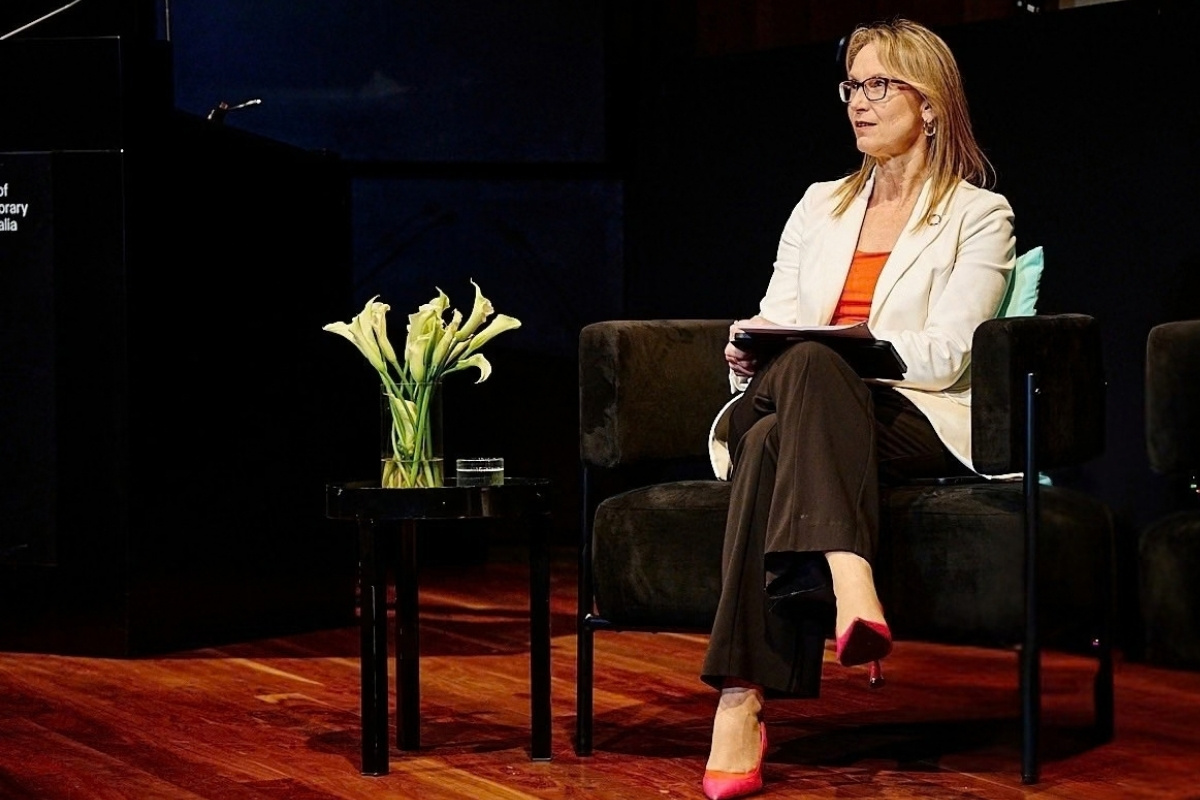
How can policy accelerate a coordinated transition to a circular fashion and textiles industry? That was the focus of the EllenMacArthur Foundation’s Fashion & Textiles 2040 policy agenda workshop, attended by Danielle Kent from Seamless, alongside policymakers, industry leaders and circular economy practitioners from around the world.
Australian State and Territory Government agencies also took part, bringing an important Australian perspective to the discussion.
Connecting policymakers and identifying priorities
A key objective of the forum was to identify priority areas for the Ellen MacArthur Foundation’s future work on fashion and textiles, helping to accelerate policy progress and implementation. Participants shared perspectives on where future policy efforts should focus and reflected on the priorities and policy instruments shaping their work on textiles.
These discussions provided a basis for comparing approaches across cities, countries and regions.
A shared direction towards 2040
The Ellen MacArthur Foundation’s 2040 policy agenda aims to move fashion and textiles from fragmented initiatives towards a shared direction. Developed with businesses across the value chain, policymakers, investors and innovators, the agenda will define a future system and identify the barriers preventing change.
It is intended to inform strategy and investment while reflecting different regional circumstances, with publication planned for early 2027.
For Seamless, participating in these policy forums is important to ensure the Australian experience and perspective are reflected in international discussions, while helping us learn from global approaches. Having Australian government representatives involved also supports a more globally informed approach to policy development here at home.
What the discussions mean for Australia
Danielle’s participation highlighted several important considerations for Australia as we work towards a more circular clothing system.
1. Aligning Australian policy with international approaches
These policy forums create opportunities to strengthen alignment between federal, state and territory clothing and textiles policies, while learning from international approaches, including Extended Producer Responsibility (EPR) schemes in countries such as France and Kenya.
Australia’s Circular Economy Framework already supports governments working together. Applying consistent measures for clothing reuse, repair and recycling would help governments and industry track progress and compare results internationally.
2. Building on product stewardship to drive circularity
The Ellen MacArthur Foundation highlights existing EPR programs in European and US jurisdictions as important mechanisms for funding the collection, sorting, reuse and recycling of unwanted textiles. These programs place responsibility on clothing brands for what happens to their products after use.
Seamless takes a broader, circular approach. As Australia’s clothing stewardship scheme, it considers the entire clothing lifecycle, from design and production through to purchasing, use, reuse, collection and recycling, with responsibility shared across the clothing value chain.
Seamless is also the first voluntary scheme to introduce eco-modulation as a key lever to encourage and financially incentivise better clothing design.
Internationally, EPR programs are increasingly exploring circular initiatives such as design and reuse, recognising the environmental and financial benefits for clothing brands and the broader supply chain. This reinforces the importance of the circular approach we are taking in Australia.
3. Developing next markets for recycled clothing and textiles
Seamless has four priorities: designing clothes that last longer and can be recycled; supporting circular business models such as repair and resale; increasing the collection, sorting and recycling of clothing and textiles; and helping Australians choose, enjoy and recirculate their clothes more purposefully.
The policy discussions reinforced the importance of developing new products, applications and markets for recycled clothing. Producing high-quality recycled materials is only part of the solution; there must also be demand for them.
This is a shared international challenge. Markets for recycled clothing and textiles are not yet operating at commercial scale, making investment in new applications and next markets essential to building a circular clothing economy in Australia and across global supply chains.
Next steps
Seamless will participate in the next policy forum, planned for February 2027, with the policy position to be discussed further at a major international roundtable in July 2027.