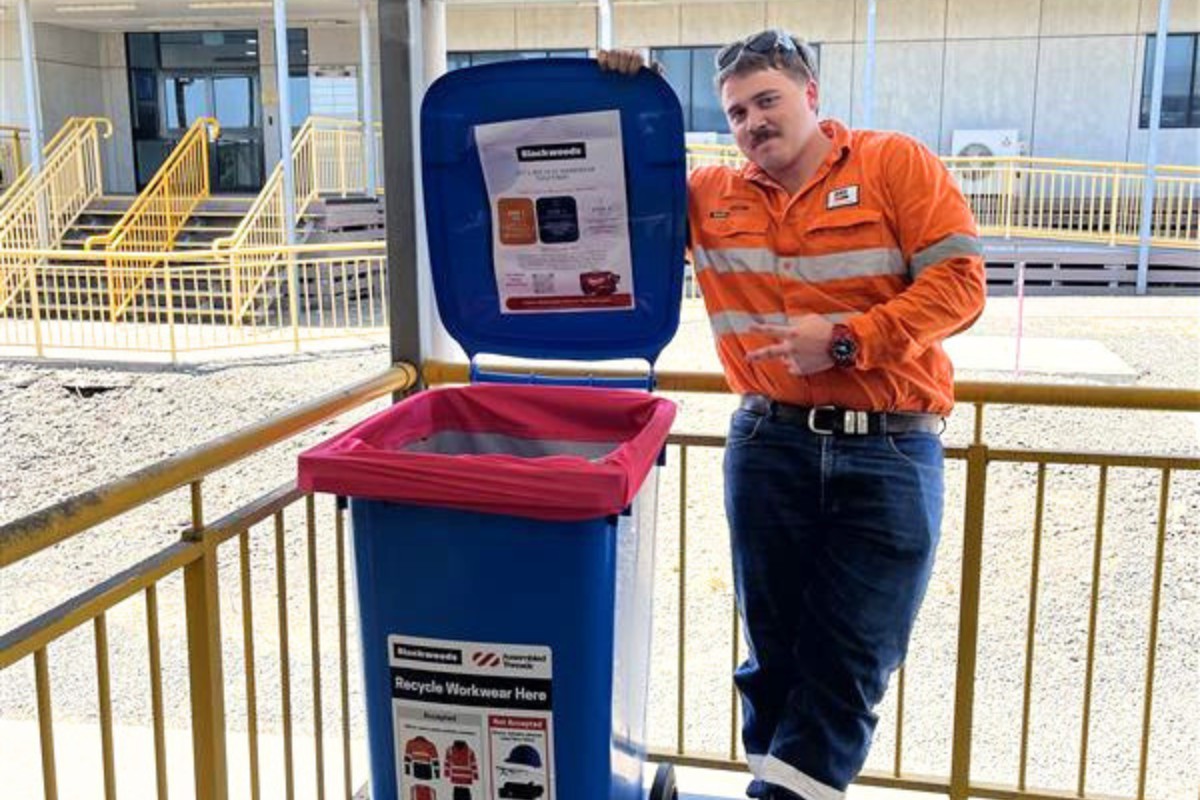
The Seamless Circular Clothing Textiles Fund is supporting practical projects like the Circular Take Back Scheme for Industrial Safety Workwear, led by Blackwoods. We spoke with Emma Mackenzie, Sustainability Manager at Blackwoods, about how used workwear can be recovered and reprocessed from some of Australia’s most remote industrial sites, in a practical, scalable way.
Describe the project you led
Blackwoods’ Circular Take Back Scheme for Industrial Safety Workwear was designed to show how used workwear can be recovered and reprocessed from some of Australia’s most remote industrial sites, in a practical and scalable way.
Through this pilot, garments were collected from three mining sites and their Brisbane headquarters, then laundered, sorted and redirected into new pathways. It demonstrated that circular systems could work in challenging environments, where landfill is often the default.
As Australia’s largest provider of industrial and safety products, Blackwoods is well placed to deliver circular solutions at scale. Through the project, used garments were diverted into three key pathways:
- Reuse: Clean, high-quality garments were redistributed through charity and community networks.
- Repair and upcycling: Social enterprises extended the life of garments through repairs, refurbishment and de-branding.
- Recycling: Items that could no longer be worn were processed through textile-to-textile recycling, creating new fibres for yarns and non-woven materials.
Alongside the take-back trial, Blackwoods partnered with Assembled Threads to launch ReTread, an online platform that redistributed more than 2,000 units of unused workwear. These garments were provided to charities, Indigenous organisations, social enterprises and community groups across Australia, diverting them from landfill while delivering social impact.
Together, these two initiatives show what a circular workwear system can look like in practice.
Tell us about your project partners
This project highlights the importance of collaboration. Each partner brought a specific capability, creating a circular system from collection through to reuse and recycling.
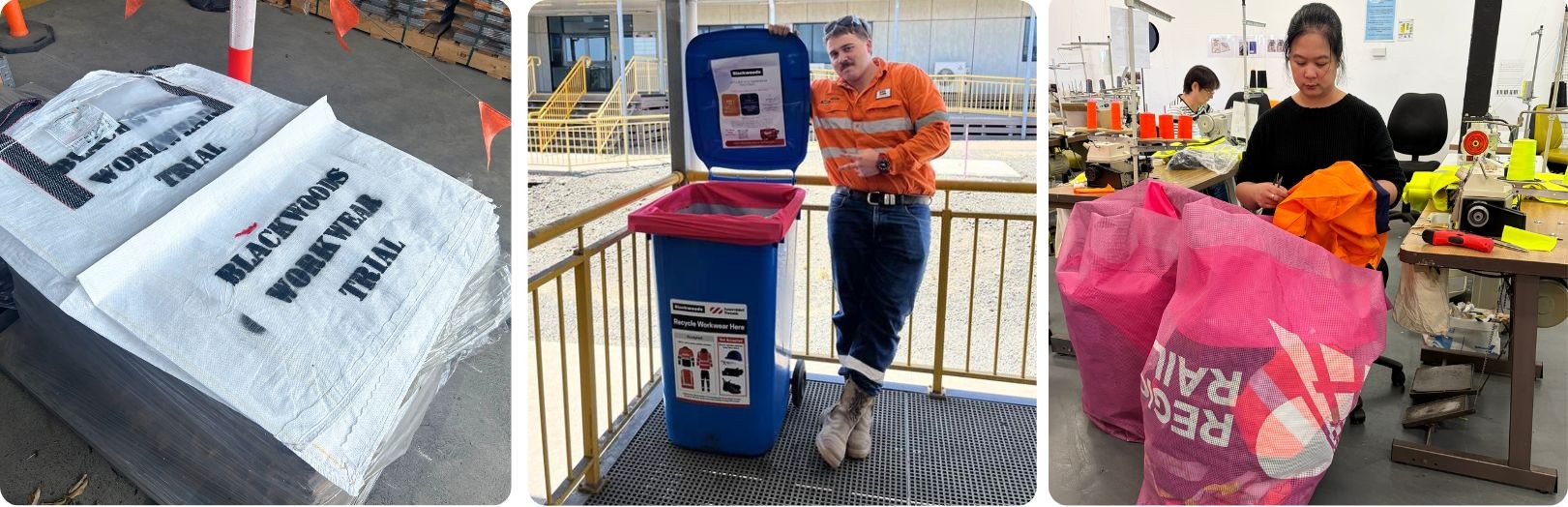
Assembled Threads is a social enterprise that sorted, de-branded, repaired and redistributed the garments. They also produced upcycled garment collection bags made from reclaimed construction mesh. Additionally, they developed and managed the ReTread platform, coordinating the national rollout and ensuring garments reached the organisations that needed them most. In total, 2,628kg of clothing was redistributed to charities, Indigenous organisations, farming communities and remote op shops through ReTread.
Wallara Logistics provided employment opportunities for people with disabilities and assisted with receiving, sorting and preparing garments. Their Keysborough facility played a key role in handling ReTread stock.
Gerrbik Launderer, an Indigenous owned organisation, ensured all garments from mining sites were professionally laundered to a high safety standard. This enabled safe handling, contamination-free sorting and improved recovery outcomes.
Textile Recyclers Group (TRG) processed non-wearable garments into recycled fibres, for use in yarns, and non-woven materials for insulation, stuffing and future workwear. Unsuitable mining uniforms (441 units) were successfully directed into this recycling pathway.
Mining partners supported the pilot by hosting uniform collection points, raising awareness and integrating the program into everyday site operations, showing that circular systems can fit into existing routines.
Together, these partners delivered an Australian model for industrial textile recovery, proving that collaboration is essential for circular textile recovery at scale.
Describe the innovative aspects of the project
The pilot delivered several important innovations:
A circular system tailored to remote mining operations: The project showed that used workwear can be safely collected and processed from remote sites, which is one of the hardest textile waste streams to capture. This included the deployment of new sealed mesh inserts for collection hubs and industrial laundering processes to ensure safe, contamination-free handling.
End-to-end visibility across reuse, repair and recycling: For the first time in Australia, detailed data was captured for industrial workwear across the entire process, from collection through to reuse and recycling. This included insights into garment materials, reuse potential, labour requirements and next markets for recycled textiles.
ReTread – A new platform for redistributing high-quality aged stock: ReTread created a simple, online and scalable way to redistribute unused workwear. By moving over 2,000 items to where they were needed, it demonstrated a practical solution for managing excess stock.
Inclusive employment embedded into every stage: The project integrated refugee and migrant workers, people with disabilities and Indigenous businesses throughout the process, showing that circular solutions can deliver both environmental and social impact at the same time.
Why is this project important to Blackwoods?
As a national leader in industrial workwear, Blackwoods has a key role to play in building a circular economy in Australia.
This project supports Blackwoods’ commitment to delivering safer, cleaner and more responsible solutions across industries including mining, construction, manufacturing, logistics, defence and government.
Blackwoods is well positioned to lead this work due to its:
- National logistics network, including six distribution centres and 40+ trade stores, enabling large-scale collection and redistribution
- Strong relationships with customers in remote regions
- Established partnerships with social enterprises, Indigenous businesses and recyclers
- Long standing expertise in workwear design, quality and safety
Circularity is a natural next step, helping reduce waste, support customers’ sustainability goals and improve product stewardship across the full life of a garment.
Tell us about the project outcomes
This pilot generated many outcomes.
Environmental outcomes
- 500 garments weighing 272.5 kg collected from mining sites
- 2,382.9 kg of textiles recycled through TRG
- 2,628 kg redistributed through reuse and donation pathways via ReTread
- Zero contamination after laundering, confirming effective safety processes
- Significant landfill diversion, including 5,283.4 kg avoided
Social outcomes
- Job creation and skills development for refugee and migrant workers, people with disabilities and Indigenous businesses
- Clothing redistributed to communities in need, including remote and bushfire-affected areas
- Stronger partnerships between industry, social enterprises and community organisations
Operational and system learnings
- High-visibilityworkwear can be successfully recycled mechanically, even with mixed materials
- Industrial laundering enables safe, low-contamination processing
- Detailed sorting data can inform better product design and recyclability
- Demand for reused workwear is strong, validating the ReTread model
National evidence base
The project demonstrates a working model for:
- Collecting textiles from remote locations
- Social enterprise-led sorting and repair
- Fibre-to-fibre recycling pathways
- Scalable reuse systems
- Data collection to support product stewardship and circular procurement
Together, the Circular Take Back Scheme and ReTread show that circular textile systems in Australia can be practical, safe and inclusive.
Blackwoods is exploring how to build on this work, reviewing the pilot outcomes, assessing the long-term potential of the ReTread platform, and continuing to support customers with circular solutions.

.jpg)