Australians are concerned about clothing waste. They want businesses to take greater responsibility for the products they put on the market, expect government to make action a priority and are prepared to contribute to better clothing recycling.
These are some of the clear messages emerging from new research commissioned by Seamless and conducted by YouGov. The findings from a poll of 1,471 Australian voters in September 2026, show that support for change extends well beyond the clothing industry. Australians recognise the problem and want to see action.
Australians are ready. It's time to act.
Seamless is calling on the Australian Government to set a target now to introduce mandatory, nationally coordinated clothing stewardship by 2029, with a clear pathway to achieve it.
Clothing waste matters to Australians
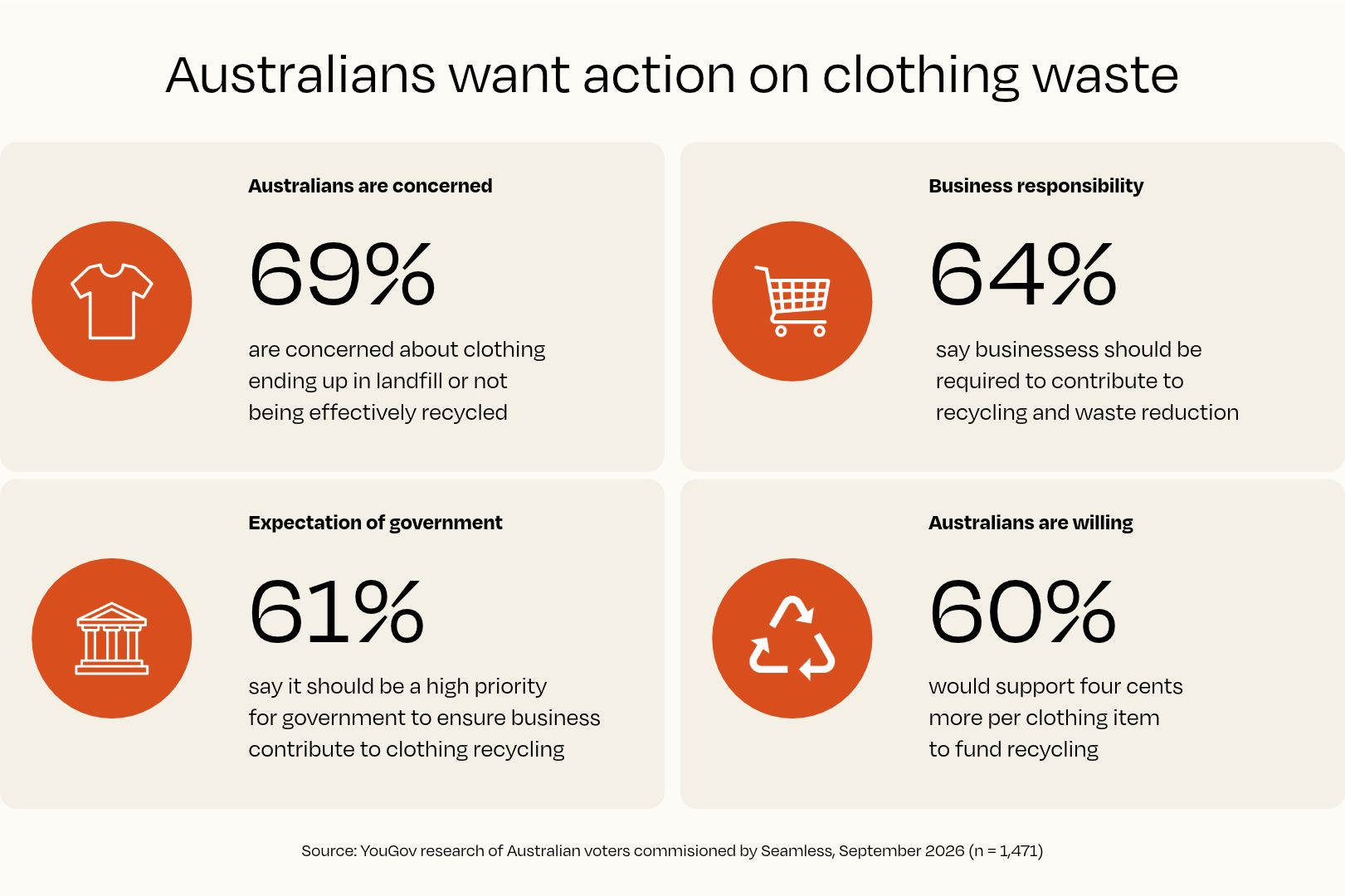
Almost seven in ten Australian voters (69%) are concerned about clothing and textiles ending up in landfill or not being effectively recycled. This includes 30% who say they are very concerned.
Too much clothing still ends up in landfill, while valuable materials are lost instead of being recovered and put to use again. These findings show that this is not just an issue for the clothing industry. It is something Australians care about and want addressed.
Australians want businesses to take responsibility
Australians also want to see businesses play their part in addressing the problem. More than six in ten voters (64%) say businesses that profit from selling products in Australia should be required to contribute to industry programs that fund recycling and waste reduction.
This support for shared responsibility is matched by a clear expectation of government action. 61% of Australian voters say introducing nationally consistent rules requiring businesses to contribute to the collection, reuse and recycling of clothing and textiles should be a high priority for the Australian Government.
Together, these findings send a strong message: Australians want businesses to take responsibility, and they expect government to establish the policy settings needed to make it happen.
Australians are prepared to contribute to the solution
There is also encouraging support for helping to fund better clothing recycling.
Six in ten voters (60%) say they would support a four cent increase in the price of a clothing item to fund more recycling.
This suggests many Australians are willing to support a modest contribution if it helps address clothing waste. It also reinforces the importance of establishing a coordinated system with sustainable funding for clothing collection, sorting, reuse and recycling.
It's time for the Australian Government to act
The findings strengthen the case for moving beyond a voluntary approach to a mandatory, nationally coordinated clothing stewardship system.
While Seamless is already working with members to improve the way clothing is designed, collected, reused and recycled, voluntary participation alone cannot deliver the scale of change needed across an industry of around 14,000 producers.
A mandatory national approach would create a level playing field and provide the certainty needed to invest in and build a national clothing system to keep valuable clothing textiles in use for longer.
The Evidence for change provided the industry data for action. Now, the public case for action is clear. The Australian Government needs to set a target for mandatory, nationally coordinated clothing stewardship by 2029, with a clear pathway to achieve it.
Read more about why Australia needs mandatory clothing stewardship in our article, From clothing waste to opportunity –the case for mandatory clothing stewardship.
Join the call for action
Seamless is calling on the Australian Government to act. We need clothing brands, retailers, reuse and recycling organisations, industry bodies and the wider community to add their voices.
Share these findings and help show that Australians are ready for change. Every post helps demonstrate that industry is ready to work with government to build a more circular, productive and resilient clothing sector.