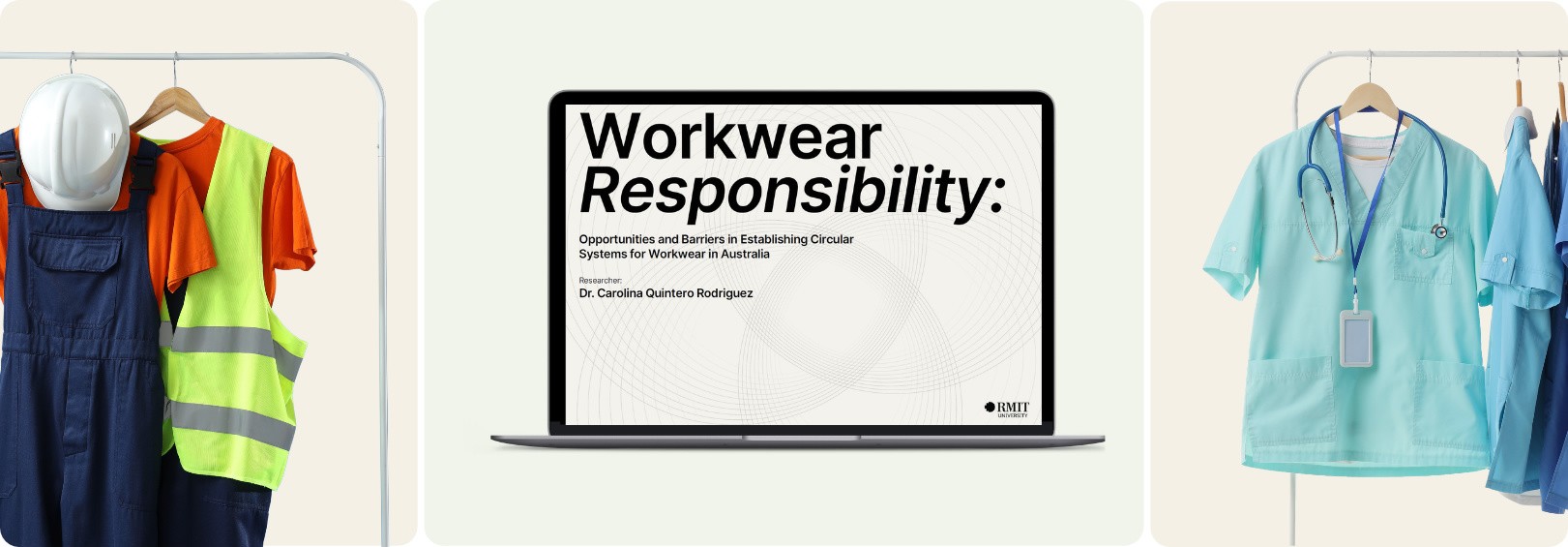
A new report, 'Workwear Responsibility: Opportunities and Barriers in Establishing Circular Systems for Workwear in Australia', explores what it will take to move towards more responsible end-of-life solutions for uniforms and workwear.
Every year, an estimated 11,000 tonnes of uniforms are discarded in Australia. Most end up in landfill, despite often being made from durable fibres that could have further use.
Authored by Dr Carolina Quintero Rodriguez, the new report, 'Workwear Responsibility: Opportunities and Barriers in Establishing Circular Systems for Workwear in Australia', was developed in partnership with Seamless and RMIT University. Download the full report from the RMIT University website.
Uniforms: an important part of the Seamless scheme
While Seamless was originally commissioned to cover clothing only, the scheme was extended to include uniforms when it became operational in July 2024.
Uniforms are a distinct material stream within the circular clothing economy. Unlike many traditional fashion business models, uniforms are centrally procured, replaced on fixed schedules, and often carry branding or safety features that can make reuse and recycling more challenging.
However, their durable and standardised characteristics also make uniforms and workwear well suited to circular models.
The 'Workwear Responsibility' report draws on interviews as well as insights from the Seamless Uniforms Working Group held in 2025. It provides a useful resource for organisations involved in uniform and workwear procurement and highlights practical ways to support more circular systems.
Key report findings
The report identifies six key findings about the current state of uniform circularity in Australia and the opportunities to improve it.
1. Uniforms are a significant waste stream. An estimated 11,000 tonnes of uniform textile waste are generated in Australia every year.
2. Good practices exist but aren't yet part of a circular system. Some uniform and workwear suppliers already offer laundering, repair and surplus redistribution services. However, the research found these activities aren't yet part of a coordinated circular framework that significantly reduces landfill or emissions.
3. Procurement is a major lever for change. Procurement contracts can include sustainability criteria, take-back arrangements and end-of-life requirements, ensuring responsibility for a garment is considered from the moment it is ordered.
4. Rental and managed services offer new opportunities. Subscription and other managed service models create opportunities for uniform providers and buyers. Because the provider retains ownership of the garments, these models can support a circular 'uniforms-as-a-service' approach.
5. System-wide barriers still need to be addressed. Participants identified challenges including brand de-identification, fibre composition, hygiene standards, performance requirements, cost pressures and limited recycling infrastructure. At the same time, they highlighted significant opportunities in rental, reuse and fibre-to-fibre recycling.
6. Collaboration is essential to progress. The research highlights the need for stronger industry collaboration, stewardship approaches and nationally aligned circular procurement practices.
Creating demand for recycled textiles
Circular textile policy in Australia is still emerging, making the evidence in this report important for both policy development and broader industry transformation.
Seamless is calling on Federal, State and Territory Governments to introduce procurement policies that create reliable demand for recycled clothing textile products. This includes specifying recycled content in uniforms, buildings, fit-outs and infrastructure projects.
Large buyers and governments can play an important role by sending a clear market signal for recycled materials. This, in turn, can help build the recycling capacity needed to address one of the barriers identified in the report. Read more about Seamless' call to unlock next markets for recycled clothing textiles.
A coordinated approach to clothing stewardship
The barriers identified in the report cannot be addressed by any single organisation alone.
Seamless is calling on the Australian Government to set a target now to introduce mandatory, nationally coordinated clothing stewardship by 2029, supported by a clear pathway to achieve it.
A nationally coordinated approach will help clothing brands, uniform suppliers, buyers, reuse operators and recyclers work together towards shared circularity goals and support development of the systems needed to keep clothing and uniforms in productive use for longer.
Read more about the case for mandatory clothing stewardship.