The Seamless Circular Clothing Textiles Fund is supporting practical initiatives that explore new ways to keep clothing out of landfill. One of these initiatives is the Sort for Good pilot, led by SCRgroup. We spoke with Kristi High, Executive Director, Corporate Affairs at SCRgroup, about Australia’s first clothing collection trial that asked people to sort their clothing before donating it.
Describe the project you’re leading
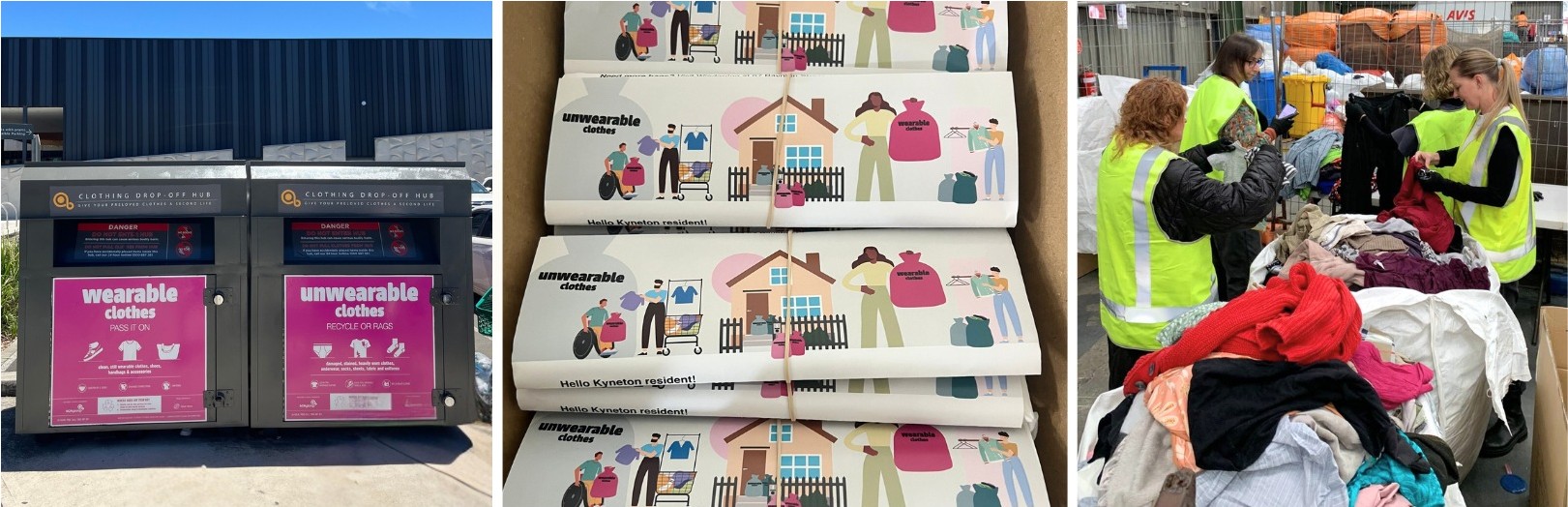
The Sort for Good pilot, delivered by SCRgroup in partnership with Reground, RMIT University and WRAP Asia Pacific, is Australia’s first multi-channel dual-stream clothing collection trial. For the first time, the project tested a system where people separated clothing that could be worn again from items that were no longer wearable, at the point of donation. The trial was supported by clear communications and dedicated collection infrastructure.
Running from October 2025 to January 2026, the pilot operated across three collection channels. Eight outdoor clothing donation hubs were installed across metropolitan Sydney and Melbourne. Excess charity stock was collected in Swan Hill and Kerang in regional Victoria. And a kerbside collection trial took place in the Macedon Ranges in Victoria, servicing around 2,500 households.
Tell us about the organisations you partnered with
Sort for Good was built on strong collaboration, recognising that no single organisation can address the challenge of diverting more than 200,000 tonnes of clothing textiles from Australian landfill each year.
SCRgroup led project governance, infrastructure deployment, logistics and material handling. Reground led community engagement, communications and education. RMIT University provided research leadership, including fibre composition analysis, contamination assessment and data collection protocols. WRAP Asia Pacific guided the evaluation framework and international benchmarking, while AusLoop supported offshore fibre-to-fibre recycling trials.
Together, these experienced and expert partners delivered an integrated pilot that spanned collection, sorting, reuse, recycling and evaluation.
Tell us about the most exciting aspects of the pilot
Sort for Good is the first coordinated trial in Australia to ask people to separate wearable and unwearable clothing at the point of donation.
The pilot tested this dual-stream system across three real-world collection environments while generating Australia’s first national dataset on clothing textiles which have reached their end-of-life. It also created a clearer link between how people donate clothing and what recycling outcomes are possible.
The project also explored new upcycling and fibre-recovery pathways. Overall, the trial demonstrated that with clear communication and the right infrastructure, communities are willing and able to participate in more advanced clothing collection systems.
How have local communities responded?
Community engagement was a key feature of the pilot, particularly through the door-to-door kerbside collection service and the outdoor clothing hubs.
A survey conducted after the pilot found that most participants described the process as clear and simple, and said separating their clothing was manageable. Participants also shared helpful feedback, including suggestions for clearer symbols and instructions, interest in understanding recycling outcomes, and requests for additional collection bags.
Overall, the response from communities was positive and showed strong willingness to participate in improved clothing recovery systems.
Tell us about what you learnt from this project
The pilot delivered several important outcomes. Around ten tonnes of clothing were collected in just three months. Locally, we also conducted detailed analysis of one tonne of clothing and additional offshore analysis was undertaken to compare sorting efficiency and recycling potential. The project also generated Australia’s first dataset on separating wearable and unwearable clothing and validated several reuse and recycling pathways.
Key learnings included the importance of clear education and simple tools, such as colour-coded bags, to improve sorting accuracy and reduce contamination. The pilot also reinforced the need for skilled sorting capabilities and showed that separating clothing earlier in the process improves recycling viability.
Overall, Sort for Good provides valuable evidence to support the design of a coordinated national clothing system. It highlights the importance of community education, workforce development, integration with municipal systems and long-term development of new markets for recycled clothing textiles.
Find out more about other pilots that were supported by the Seamless Circular Clothing Textiles Fund.
Images provided by SCRgroup
.jpg)