The Seamless Circular Clothing Textiles Fund is supporting practical initiatives, such as Project ReCarbon, which is led by Vital Chemical. We sat down with Letiscia Xavier, Director and Chief Scientist at Vital Chemical, to discover how clothing is collected and ultimately returned to construction sites as hydromulch for revegetation.
Describe the project you’re leading
Project ReCarbon is an Australian‑first pilot being led by Vital Chemical, an Australian owned leader in practical environmental solutions for civil and construction, mining, residential and commercial development, land rehabilitation and renewables.
Delivered in partnership with Earth Systems, Georgiou, Textile Recyclers Group and Salvos Stores, Project ReCarbon is collecting high visibility (hi-vis) workwear from Australian construction sites, and unwearable everyday clothing, and converting it into textile biochar using advanced pyrolysis technology.
The resulting clean carbon is then incorporated into hydromulch for revegetation and returned to the construction sites the clothing came from. It’s a truly circular solution for diverting clothing textiles from landfill.
Tell us about the organisations you’re partnering with
Project ReCarbon brings together organisations who are specialists in their field, to create a practical, fully onshore circular model for keeping clothing textiles out of landfill and recovering valuable carbon.
Earth Systems is Vital Chemical’s innovation partner for textile pyrolysis, which is a process that breaks down textile waste using high heat in a low-oxygen environment. Instead of burning the material, the heat causes the fibres to thermally decompose and transform textile structures into a new carbon product. Using its innovative technology and expertise in stable biocarbon production and emissions testing, Earth Systems helps ensure the process is safe, effective and meets regulatory requirements.
The Georgiou Group is the project’s construction industry partner. Employees donate unwearable hi-vis workwear and everyday clothing through collection bins at Georgiou sites and offices. At the end of the process, this clothing is returned to the Georgiou construction sites as a hydromulch component, delivering a circular solution via carbon return to the soil to promote revegetation growth.
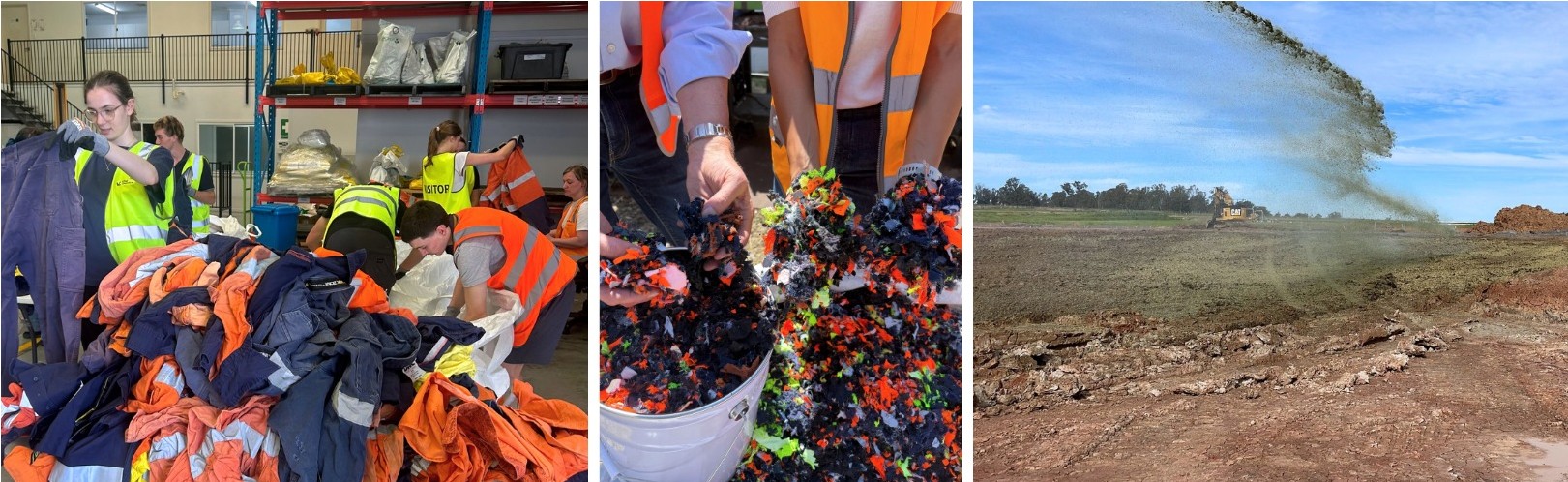
Textile Recyclers Group prepares the donated garments for processing. The clothing is decommissioned to remove non-textile components such as buttons and zips for recycling, and the fabric is shredded so it can be used as feedstock, ready for pyrolysis.
Salvos Stores is the project’s social enterprise partner. Any donated clothing that can still be worn is passed on to Salvos Stores for resale, helping fund their community programs.
Together, these partners create a circular supply chain. Wearable clothing is given a new life through Salvos Stores, while clothes that can’t be worn again are transformed into recovered carbon. This supports grass and plant growth on construction sites, diverts clothing from landfill and reduces emissions from future decomposition.
Tell us why this is an Australian-first
Project ReCarbon is an Australian-first initiative for diverting end-of-life clothing textiles from landfill. Using continuous pyrolysis, large volumes of unwearable clothing can be converted into a much smaller amount of stable carbon, reducing the original volume by up to two-thirds. The process largely powers itself using heat generated through the process and can break down contaminants, including persistent chemicals such as PFAs that are often found in workwear.
Another exciting aspect is what happens next. Carbon from natural fibres like cotton is returned to the soil, improving soil health and supporting revegetation. This project is the first time textile-derived biochar is being trialled in Australia as a soil amendment in hydromulch on civil and construction sites.
Because pyrolysis relies on heat rather than chemical treatments, the process avoids adding new chemicals and doesn’t use significant amounts of non-renewable energy. By turning hard-to-recycle textiles into a useful product that supports plant growth, Project ReCarbon is an exciting and practical new pathway for keeping clothing out of landfill.
Explain how this project is a practical circular solution
Project ReCarbon was designed to make circularity simple – from clothing collection through to distribution of the final output. Unwearable hi-vis workwear is collected directly from Georgiou construction sites through dedicated hubs, making it easy for workers to donate clothing as part of their everyday routines.
Once collected, the garments follow a clear processing pathway. Items are sorted systematically, non-fabric components such as buttons and zips are removed, and the textiles are shredded to prepare them for pyrolysis. The process reduces the material volume and produces a clean carbon product, all without additional chemical inputs or significant use of non-renewable energy. Every stage is carried out collaboratively by Australian organisations, keeping the system fully onshore and transparent.
The circular loop is completed when the textile-derived biochar is blended into hydromulch and applied back to a Georgiou construction site. The recovered carbon is returned to the location where the clothing originally came from – a truly circular solution for diverting clothing textiles from landfill.
Tell us about what you’ve learnt
One key learning was the value of engaging workers directly at the point where clothing is discarded. Collecting textiles on active construction sites led to strong participation and provides a realistic picture of the waste stream. It highlights how simple, convenient systems can encourage people to take part in clothing recovery.
The project also showed the power of collaboration. Each partner brought specialist expertise, from textile collection and sorting to pyrolysis, emissions testing and soil application. This shared-responsibility model provides a useful example of how different sectors can work together to support circular clothing systems.
Technically, the project demonstrated that Australia has the capability to recover carbon from complex textile materials using controlled pyrolysis without additional chemical inputs and the use of large amounts of non-renewable energy. Data collected across the project, including collection volumes, contamination levels, emissions performance and biochar characteristics, helps build a practical evidence base for how a coordinated national clothing recovery system could operate.
Find out more about other pilots that were supported by the Seamless Circular Clothing Textiles Fund.
Photos courtesy of Vital Chemical.
.jpg)