
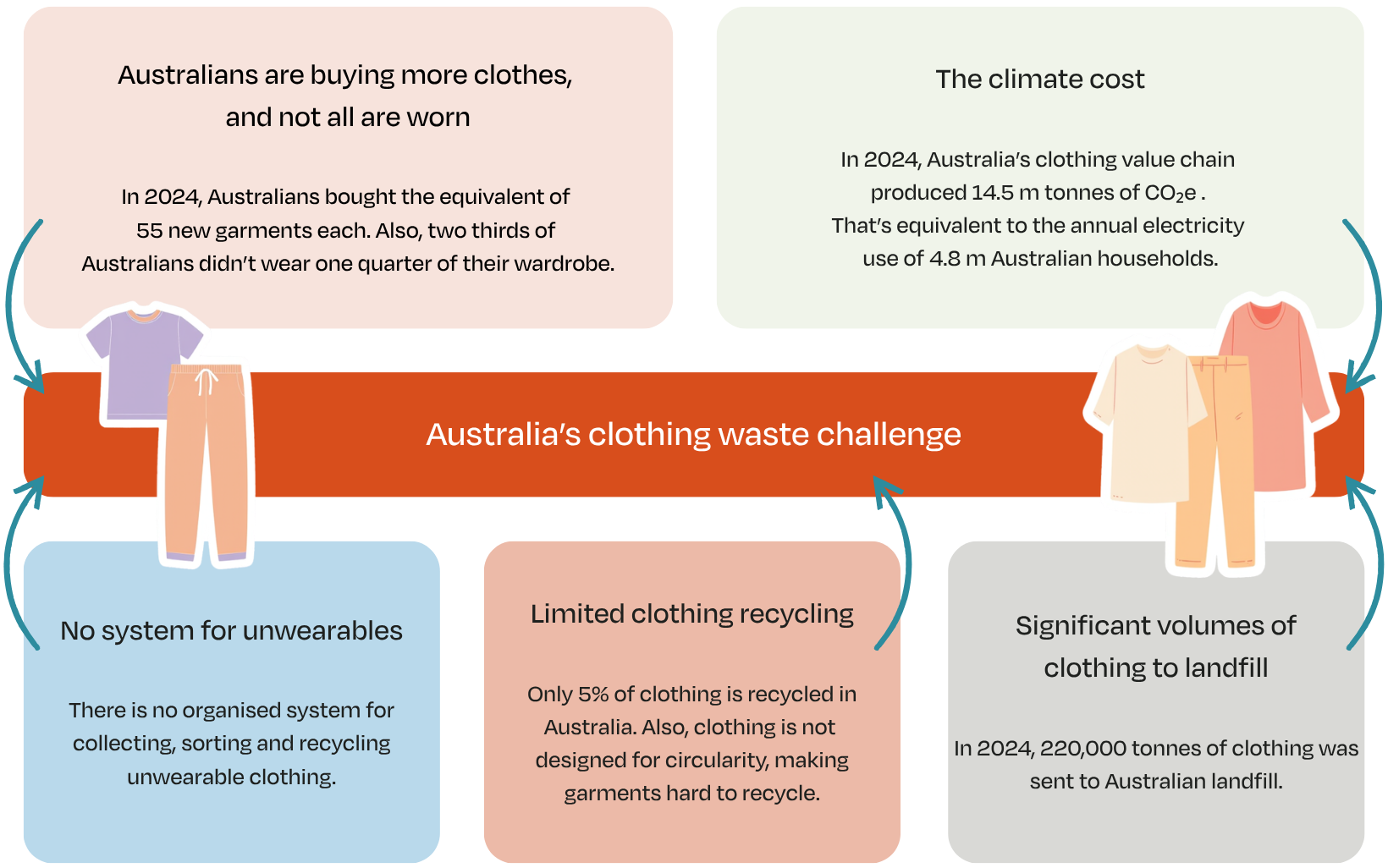
In 2024, Australians purchased 1.51 billion items of clothing, which equates to 55 items for every Australian, a high figure by global standards. Much of this clothing was made from materials that are not designed to last or be recycled. As a result, 220,000 tonnes of clothing textiles were sent to Australian landfill.
Additionally, there is currently no nationally coordinated system to collect and process unwearable clothing. Existing infrastructure for reuse and recycling is limited, and much of it is not equipped to deal with current clothing volumes.
Systemic change is needed to transition Australia to a vibrant, productive circular economy, where clothing is valued as an asset.
A linear system driving waste
Australia’s clothing industry largely operates on a linear model: take, make and dispose. This approach undervalues the resources, labour and energy embedded in clothing and leads to significant material loss.
Clothing is also under used. In 2024, around 3% of imported clothing, equivalent to 47 million items or 11,700 tonnes, was never sold. At the same time, two-thirds of Australians reported not wearing at least one quarter of their wardrobe in the past year. Pace is being prioritised over purpose and value, and we need to shift from over production and under utilisation of our clothing assets.
Most garments are also not designed with recycling in mind. Complex fibre blends, trims and chemical treatments make it difficult and often uneconomical to recover materials at end of life. As a result, valuable resources are lost, along with the opportunity to retain economic value within Australia.
Ineffective systems limit pathways for clothing recovery
Current clothing collection and sorting systems are largely driven by charitable organisations and are designed to support the resale of wearable clothing. However, only around 16% of donated items are suitable for resale within Australia. The majority are lower-grade items, often exported for reuse or recycling overseas, where much of their value is lost to the domestic economy.
For unwearable clothing, there are few viable pathways. Less than 5% of textiles are recycled in Australia, and domestic processing capacity is underdeveloped. This lack of onshore infrastructure and next markets for recycled clothing limits the ability to recover materials and creates a reliance on landfill or offshore solutions.
The combined impact is significant: the loss of valuable materials and labour, increased greenhouse gas emissions, and growing pressure on landfills.
Clothing as a national priority
Recognising the scale of the issue, clothing was listed as a priority product on the Environment Ministers Priority List in 2021-22. This places responsibility on industry to act and reduce the environmental impacts associated with clothing across its lifecycle.
Despite its designation as a priority product, progress on addressing clothing waste to date has been limited. The evidence shows that incremental change will not be enough. A national coordinated approach is needed to reduce clothing landfills, recover valuable materials and transition Australia to a circular clothing economy.
Without structural intervention, Australia will be unable to deliver the scale of change required to transition to a circular economy and meet the Australian Government’s Circular Economy Framework targets by 2035.
Sources
Productivity Commission. (2026), Australia’s circular economy: unlocking the opportunities.
Seamless (2025), Seamless 2024 National Clothing Benchmark for Australia.
Payne, A., Jiang, X., Street, P., Leenders, M., Nguyen, N.,Pervan, S., Tan, C. (2024). Keeping Clothes Out of Landfill: A landscape study of Australian consumer practices. RMIT University.
MRA Consulting. (2021), Charitable Recycling Australia: Measuring the Impact of the Charitable Reuse and Recycling Sector.
RPS Group (2026), National clothing scheme: Policy, economic and financial analysis.
Seamless (2025), Environmental Impact of the Australian Clothing Industry 2024.

.jpg)